

Rural Washington: Thirty Billboards, the Future Electorate, and National Security

Make Rural Voices Count expands, demographic change reshapes our communities, and Rural America's Project 2028 turns to national security.

Make Rural Voices Count Expands Voter Engagement Across Rural Washington
For decades, many rural communities have heard only one side of the political conversation.
That is beginning to change.
The Tri City Herald recently featured Make Rural Voices Count, our three year effort to increase visibility, representation, and voter participation throughout rural Washington.
Fifteen Make Rural Voices Count billboards are now live across Central Washington. They are the opening phase of a long term effort to strengthen civic participation and representation in rural communities.
In 2026 alone, Rural Americans United is investing more than $200,000 in voter engagement through billboards, newly registered voter outreach, community workshops, polling, voter information resources, and community partnerships.

The campaign was built through community workshops, stakeholder discussions, and partnerships with organizations throughout rural Washington. The themes, language, and priorities reflected on the billboards come directly from the people and communities they are intended to serve.
The goal is simple: create a visible reminder that every community matters, every voice deserves to be heard, and every vote has value.
Why Billboards Matter for Rural Voter Engagement
The decision to use billboards was intentional.
Rural communities are saturated with commercial advertising, yet messages encouraging civic participation and representation are rarely seen outside of election season. A billboard reaches thousands of people every day and remains visible long after a social media post disappears from view.
Billboards also create something digital communication often cannot: shared visibility. Everyone traveling a highway sees the same message. Conversations begin at kitchen tables, coffee shops, workplaces, and community events. Over time, those conversations help build a culture of participation.
Building Civic Participation Through 2028
Lasting civic engagement is not built in a single election cycle.
Make Rural Voices Count was designed as a three year effort because meaningful change requires consistency. The project begins with thirty billboards and voter outreach in 2026, expands through local elections in 2027, and continues through the 2028 presidential election.
The objective is larger than any individual race. It is to strengthen civic infrastructure, increase participation, and help ensure that rural communities remain active participants in shaping their future.

Building Toward 2028
The first phase of Make Rural Voices Count is fully funded.
We are now building support for fifteen additional billboards ahead of the 2026 election and continued expansion through 2027 and 2028.
Supporters across Washington have already stepped forward to help bring this project to life. Every new billboard increases visibility. Every new voter reached strengthens participation. Every conversation helps build a more representative future.
Support the Next Phase
A six month billboard sponsorship costs approximately $3,000. All donations are welcome. Every contribution helps bring Make Rural Voices Count to more communities across rural Washington.
Donations to Make Rural Voices Count are made through the Rural Americans United Education Foundation, a 501(c)(3) nonprofit organization.
Visit our website for more information.
Washington's Future Electorate Already Exists
Most political analysis assumes demographic change is something that will happen in the future.
The data says otherwise.
That means the next generation of Washington voters is already nearly twice as Hispanic as today's adult population.
The implications are enormous.
In Adams County, Hispanic children make up nearly 73% of all kids. In Franklin County, 67%. In Yakima County, 63%. In Grant County, 55%.
These are not small shifts. They represent the future electorate of Central Washington.
The most striking example may be Walla Walla County. Hispanic residents account for only 19% of adults today, yet more than 41% of children. Chelan and Douglas counties show similar gaps of roughly twenty percentage points between children and adults.
 |
The political consequences are unavoidable.
The electorate that chooses county commissioners, school board members, city councils, legislators, members of Congress, and eventually governors and senators is already growing up in Washington classrooms.
And Hispanic voting power is likely to grow even faster than these numbers suggest.
The 11.4% adult figure includes noncitizens and others who are not yet eligible to vote. Hispanic residents remain underrepresented in today's electorate relative to their share of the population. As younger generations reach voting age, that gap will narrow.
In county after county, the people entering adulthood look very different from the people currently dominating elections.
This is not limited to Central Washington. Lewis, Cowlitz, Klickitat, Mason, Grays Harbor, and Skagit counties all show Hispanic youth populations far larger than their adult populations. Even in the Puget Sound region, where the gaps are smaller, the sheer size of the population means hundreds of thousands of future Hispanic voters are already in the pipeline.
There are a few statistical exceptions. Retiree destinations such as San Juan and Pacific counties have unusually old adult populations, which widens the gap. Whitman County's large university population inflates the adult share.
But those exceptions do not change the larger story.
Washington's electorate is changing.
Not someday.
Right now.
The children sitting in classrooms in Yakima, Pasco, Othello, Wenatchee, Moses Lake, Mount Vernon, Vancouver, and Seattle will help define the state's politics for the next half century.
The future electorate is not coming.
It is already here.
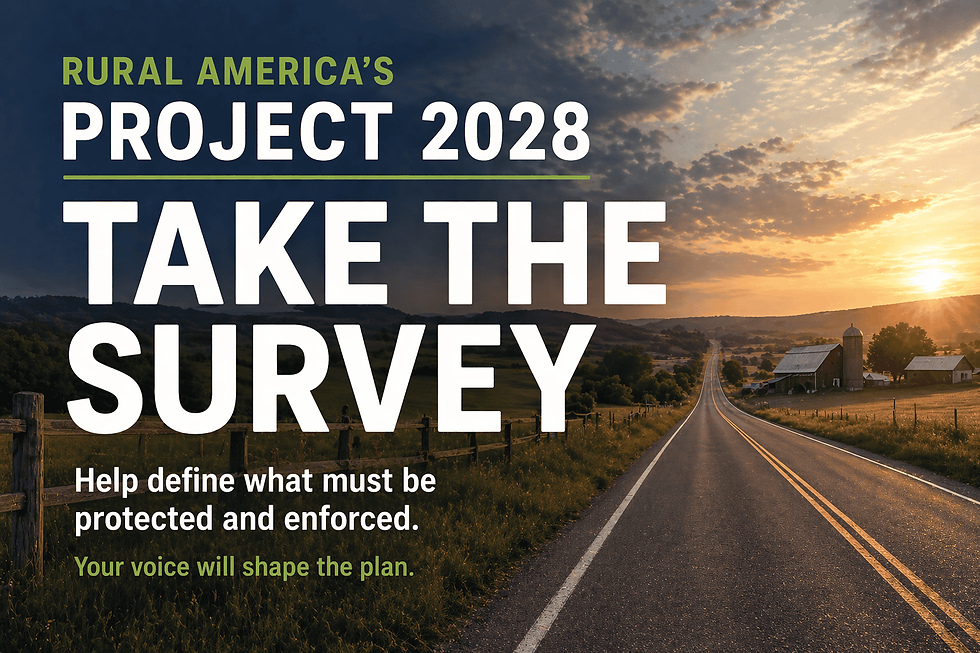
Project 2028: National Security Begins at Home
The first phase of Rural America's Project 2028 asked a simple question:
What must exist for America to remain a strong democracy?
The responses were remarkably consistent.
People wanted accountability. They wanted independent institutions. They wanted laws applied equally. They wanted access to healthcare, quality education, economic opportunity, reliable infrastructure, and trustworthy information.
Most important, people recognized that values alone are not enough.
Freedom requires institutions.
Opportunity requires investment.
Accountability requires enforcement.
Democracy requires structures strong enough to survive changes in leadership, political pressure, and economic uncertainty.
That insight leads naturally to the next question.
What makes a nation secure?
Many Americans think of national security primarily in military terms. We think about troops, weapons systems, intelligence agencies, and threats from abroad.
Those things matter.
But the responses to Project 2028 suggest a broader understanding.
A nation is secure when its people are healthy. When children receive a quality education. When food and water systems are reliable. When infrastructure works. When institutions are trusted. When citizens believe the law applies equally to everyone.
National security begins with the conditions that allow a society to function, prosper, and withstand crisis.
Military strength protects a nation from external threats.
Strong institutions, healthy communities, and economic stability protect it from internal decline.
The strength of a nation begins with the strength of its people.
If that is true, then the question before us is clear:
What structures must exist to protect that strength for generations?


Comments